Tag Archive for robot

Plane | Working handshake code demo

First off, here’s a video:

If you’re a long time follower of the blog, than you may notice that it looks like I’m backtracking here. Let me go over the differences between the two systems I’ve developed.

The one I “finished” a few months ago can be found here. While the code is “good” and it works well for what it does, there are a few inherent problems with it. The first being that it has to have a computer to be used. The second being that the computer running the intermediate program has to be extremely fast, so it’s not totally feasible for field use. It would also be very hard for it to go wireless, but I had built that groundwork in so it could happen.

The one I’m working on now doesn’t require a computer as an intermediate, and is going to be totally wireless as from the start.

This morning I finished the handshake data exchange over xbee. Right now it’s just dimming a few LED’s but if you take a peek at the following code, it’s very expandable.

Here’s the working code:


#include <SoftwareSerial.h>
SoftwareSerial xbee_serial(2, 3); 
#include <string.h> // we'll need this for subString
#define MAX_STRING_LEN 20 // like 3 lines above, change as needed. 

int in_LED = 10;
int out_LED = 11;

int input = 2;

int sendval;


//serial stuff
const char EOPmarker = '.';  //This is the end of packet marker
char serialbuf[32]; //This gives the incoming serial some room. Change it if you want a longer incoming.

void setup(){
  pinMode(in_LED, OUTPUT);
  pinMode(out_LED, OUTPUT);
  pinMode(input, INPUT);
  
  Serial.begin(9600);
  xbee_serial.begin(9600);
  
  xbee_serial.print("0,0,0."); // this is very important as it starts of the loop because it makes "xbee_serial.avalible() > 0. 
}

void loop(){
  if (xbee_serial.available() > 0) { 
    static int bufpos = 0;
    char inchar = xbee_serial.read();
      if (inchar != EOPmarker) { 
        serialbuf[bufpos] = inchar; 
        bufpos++; 
      }
      else {
        serialbuf[bufpos] = 0; //restart the buff
        bufpos = 0; //restart the position of the buff

        Serial.println(atoi(subStr(serialbuf, "," , 1)));
        analogWrite(in_LED, atoi(subStr(serialbuf, "," , 1)));
        
         sendval = map(analogRead(input), 0, 1023, 0, 255);
         xbee_serial.print(sendval); // Value that it sends over the serial
         xbee_serial.print(",");
         xbee_serial.print("100"); //This second byte is for the purpose of the program, it is not being used. 
         xbee_serial.print("."); //EOP marker
         analogWrite(out_LED , sendval);
        
    }
  }
  
  //delay(10);
}

char* subStr (char* input_string, char *separator, int segment_number) {
 char *act, *sub, *ptr;
 static char copy[MAX_STRING_LEN];
 int i;
 
 strcpy(copy, input_string);
 
for (i = 1, act = copy; i <= segment_number; i++, act = NULL) {
 
 sub = strtok_r(act, separator, &ptr);
 if (sub == NULL) break;
 }
 return sub;
}

Plane | Corrective Balancing Mechanism

First of all, here’s a video of this device in action.


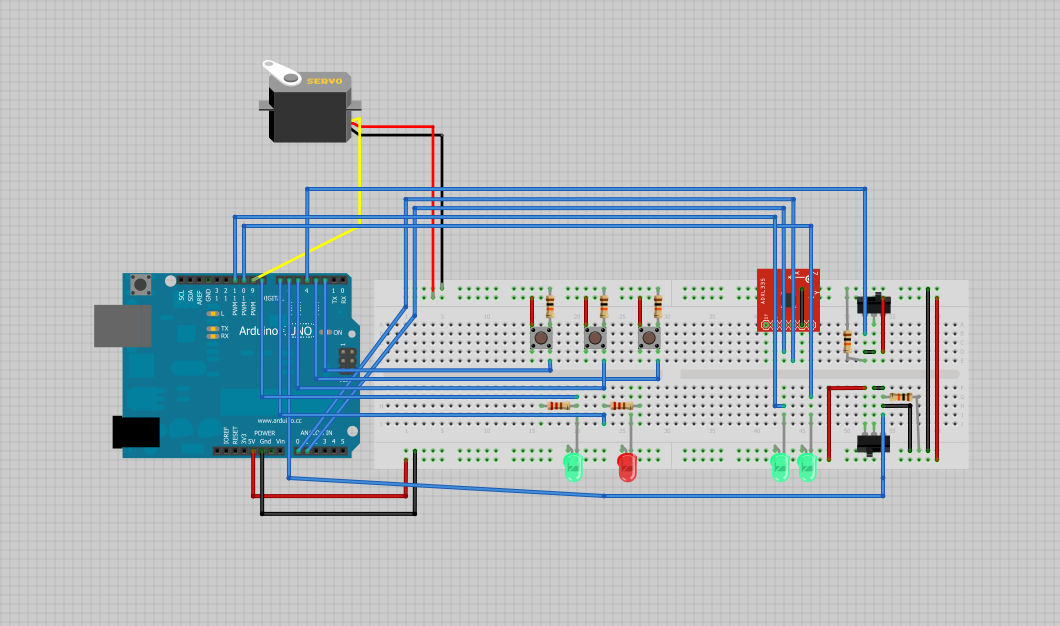
So things are really starting to take shape with the plane (still unnamed…) and I’ve got a really solid framework for an auto-balancing system. Basically the program below maps the x value given from the ADXL335 to a value from 1-180 on the servo. A lot of this code is for debug, but that portion can be switched off.

</pre>
#include <Servo.h>

Servo myservo;

int raw_val;
int ref_val;
int mid_val = 336;

int left_tilt = 260;
int rght_tilt = 405;

int min_switch = 2;
int max_switch = 3;
int mid_switch = 5;
int mode_switch = 4;

int debug_switch = 6;

int bounds_LED = 10;
int mid_LED = 11;

int debug_LED = 7;
int normal_LED = 8;

void setup(){

 pinMode(min_switch, INPUT);
 pinMode(max_switch, INPUT);
 pinMode(mid_switch, INPUT);
 pinMode(debug_switch, INPUT);

 pinMode(mode_switch, INPUT);

 pinMode(bounds_LED, OUTPUT);
 pinMode(mid_LED, OUTPUT);

 pinMode(debug_LED, OUTPUT);
 pinMode(normal_LED, OUTPUT);

 Serial.begin(9600);
 myservo.attach(9);
}

void loop(){
 if (digitalRead(debug_switch) == HIGH) {

 digitalWrite(debug_LED, HIGH);
 digitalWrite(normal_LED, LOW);

 raw_val = analogRead(0);

 if (digitalRead(mode_switch) == HIGH) {

 digitalWrite(bounds_LED, HIGH);
 digitalWrite(mid_LED, LOW);

 Serial.print("BOUNDS MODE: ");

 ref_val = map(raw_val, left_tilt, rght_tilt, 0, 180);

 myservo.write(ref_val);

 if (digitalRead(min_switch) == HIGH){
 Serial.print("LEFT HGH");
 left_tilt = raw_val;
 }

 if (digitalRead(min_switch) == LOW){
 Serial.print("LEFT LOW");
 }

 Serial.print(" , ");

 if (digitalRead(max_switch) == HIGH){
 Serial.print("RGHT HGH");
 rght_tilt = raw_val;
 }

 if (digitalRead(max_switch) == LOW){
 Serial.print("RHGT LOW");
 }

 Serial.print(" , ");

 Serial.print("Left Tilt: ");
 Serial.print(left_tilt);

 Serial.print("Rght Tilt: ");
 Serial.print(rght_tilt);

 }

 if (digitalRead(mode_switch) == LOW) {

 Serial.print("MID MODE:");

 if (digitalRead(mid_switch) == HIGH){
 mid_val = raw_val;
 }

 int MLeft_val = mid_val - 75;
 int MRght_val = mid_val + 75;

 ref_val = map(raw_val, MLeft_val, MRght_val, 0, 180);
 myservo.write(ref_val);

 digitalWrite(bounds_LED, LOW);
 digitalWrite(mid_LED, HIGH);

 Serial.print(" , ");
 Serial.print("Left Most Value: ");
 Serial.print(MLeft_val);
 Serial.print(" , ");
 Serial.print("Rght Most Value: ");
 Serial.print(MRght_val);
 Serial.print(" , ");
 Serial.print(mid_val);

 }
 Serial.print(" , ");
 Serial.print("Raw Value: ");
 Serial.print(raw_val);
 Serial.print(" , ");
 Serial.print("Current Servo Value: ");
 Serial.print(ref_val);

 Serial.println("");
}

 if (digitalRead(debug_switch) == LOW) {

 digitalWrite(debug_LED, LOW);
 digitalWrite(normal_LED, HIGH);

 raw_val = analogRead(0);
 if (digitalRead(mode_switch) == HIGH) {
 digitalWrite(bounds_LED, HIGH);
 digitalWrite(mid_LED, LOW);
 ref_val = map(raw_val, left_tilt, rght_tilt, 0, 180);
 myservo.write(ref_val);
 if (digitalRead(min_switch) == HIGH){
 left_tilt = raw_val;
 }
 if (digitalRead(max_switch) == HIGH){
 rght_tilt = raw_val;
 }
 }

 if (digitalRead(mode_switch) == LOW) {
 if (digitalRead(mid_switch) == HIGH){
 mid_val = raw_val;
 }<a href="http://www.esologic.com/wp-content/uploads/2012/12/2012-12-27_14-20-51_644.jpg">
</a>
 int MLeft_val = mid_val - 75;
 int MRght_val = mid_val + 75;
 ref_val = map(raw_val, MLeft_val, MRght_val, 0, 180);
 myservo.write(ref_val);
 digitalWrite(bounds_LED, LOW);
 digitalWrite(mid_LED, HIGH);
 }
 }
}

Sorry for the lack of comments in this code, it’s pretty intuitive though, at it’s core its all about the map command.

Here’s a picture of what my desk looks like:


Here’s a picture of the fritzing document, which can be found: here

Thanks for reading!