Tag Archive for Arduino

Plane | Ground based system all working! [Demonstration]

Pretty big day for me today. Here’s a video:

I’m pretty proud of this one, the only problem of this is that the l298N get’s too hot, you can see in the pictures that I’ve installed a makeshift heatsink but it still get’s really hot:

Motor Driver 1

I also installed the 5v@3a regulator I mentioned in the last post, here are some pictures:


Here’s the vehicle code:

//Serial Handshake declaration
#include  // we'll need this for subString
#define MAX_STRING_LEN 20 // like 3 lines above, change as needed.
const char EOPmarker = '.';  //This is the end of packet marker
char serialbuf[32]; //This gives the incoming serial some room. Change it if you want a longer incoming.

//SoftwareSerial declaration
#include
SoftwareSerial xbee_serial(8, 9);

//Shift Register Pins declaration
int SER_Pin = 10;   //pin 14 on the 75HC595
int RCLK_Pin = 11;  //pin 12 on the 75HC595
int SRCLK_Pin = 12; //pin 11 on the 75HC595
#define number_of_74hc595s 1 //How many of the shift registers - change this
#define numOfRegisterPins number_of_74hc595s * 8 //do not touch
boolean registers[numOfRegisterPins];

//Servo declarations
#include
Servo left_servo;
Servo rght_servo;

//Misc Pin declaration

//inputs
int pot = 1;
int debug_switch1 = 4;

//outputs
int fade_LED = 13;
int x_LED = 5;
int y_LED = 6;
//int debug_switch1_LED = 12;

//Misc Integer declarations
int brightness = 0;    // how bright the LED is
int fadeAmount = 20;    // how many points to fade the LED by

int x_upperTrigger = 600;
int x_lowerTrigger = 400;
int y_upperTrigger = 600;
int y_lowerTrigger = 400;

void setup(){
  Serial.begin(9600);
  xbee_serial.begin(9600);

  pinMode(SER_Pin, OUTPUT);
  pinMode(RCLK_Pin, OUTPUT);
  pinMode(SRCLK_Pin, OUTPUT);
  pinMode(0, INPUT);
  clearRegisters();
  writeRegisters();

  pinMode(pot, INPUT);
  pinMode(debug_switch1, INPUT);

  pinMode(x_LED, OUTPUT);
  pinMode(y_LED, OUTPUT);
  pinMode(fade_LED, OUTPUT);

  xbee_serial.print("0,0,0."); // this is very important as it starts of the loop because it makes "xbee_serial.avalible() > 0.
}

void loop(){
  if (xbee_serial.available() > 0) {
    static int bufpos = 0;
    char inchar = xbee_serial.read();
      if (inchar != EOPmarker) {
        serialbuf[bufpos] = inchar;
        bufpos++;
      }
      else {
        serialbuf[bufpos] = 0; //restart the buff
        bufpos = 0; //restart the position of the buff

          handshake();
          debug_handshake();

          setRegisterPin(1, HIGH);
          writeRegisters();

    }
  }
}

void handshake(){
  //input, recived from controller
  // led1val,ledval2,fade_LEDvalue.

  //analogWrite(x_LED, map(atoi(subStr(serialbuf, "," , 1)),0,1023,0,255));
  //analogWrite(y_LED, map(atoi(subStr(serialbuf, "," , 2)),0,1023,0,255));
  analogWrite(fade_LED, atoi(subStr(serialbuf, "," , 3)));

  brightness = brightness + fadeAmount;
  // reverse the direction of the fading at the ends of the fade:
  if (brightness == 0 || brightness == 255) {
    fadeAmount = -fadeAmount ;
  }

  if (atoi(subStr(serialbuf, "," , 1)) > x_upperTrigger ){
    analogWrite(x_LED, map(atoi(subStr(serialbuf, "," , 1)),512,1023,0,255));
    setRegisterPin(2, HIGH);
    setRegisterPin(3, LOW);
    writeRegisters();
  }

  if (atoi(subStr(serialbuf, "," , 1)) < x_lowerTrigger ){
    analogWrite(x_LED, map(atoi(subStr(serialbuf, "," , 1)),512,0,0,255));
    setRegisterPin(2, LOW);
    setRegisterPin(3, HIGH);
    writeRegisters();
  }

  if (atoi(subStr(serialbuf, "," , 1)) > x_lowerTrigger && atoi(subStr(serialbuf, "," , 1)) < x_upperTrigger){
    setRegisterPin(2, LOW);
    setRegisterPin(3, LOW);
    writeRegisters();
  }

  if (atoi(subStr(serialbuf, "," , 2)) > y_upperTrigger ){
    analogWrite(y_LED, map(atoi(subStr(serialbuf, "," , 2)),512,1023,0,255));
    setRegisterPin(4, HIGH);
    setRegisterPin(5, LOW);
    writeRegisters();
  }

  if (atoi(subStr(serialbuf, "," , 2)) < y_lowerTrigger ){
    analogWrite(y_LED, map(atoi(subStr(serialbuf, "," , 2)),512,0,0,255));
    setRegisterPin(4, LOW);
    setRegisterPin(5, HIGH);
    writeRegisters();
  }

  if (atoi(subStr(serialbuf, "," , 2)) > y_lowerTrigger && atoi(subStr(serialbuf, "," , 2)) < y_upperTrigger){
    setRegisterPin(4, LOW);
    setRegisterPin(5, LOW);
    writeRegisters();
  }

  //output, sent to controller
  //ledpot1,fade_LEDval.
  xbee_serial.print(analogRead(pot));
  xbee_serial.print(",");
  xbee_serial.print(brightness); //This second byte is for the purpose of the program, it is not being used.
  xbee_serial.print("."); //EOP marker
  delay(10);
}

void debug_handshake(){
  //input, recived from controller
  Serial.print("VEHICLE DEBUG: ");
  Serial.print("INPUTS|");
  Serial.print(" x_LED: ");
  Serial.print(map(atoi(subStr(serialbuf, "," , 1)),0,1023,0,255));
  Serial.print(" y_LED: ");
  Serial.print(map(atoi(subStr(serialbuf, "," , 2)),0,1023,0,255));
  Serial.print(" in fade_LED: ");
  Serial.print(atoi(subStr(serialbuf, "," , 3)));

  //output, sent to controller
  Serial.print(" OUTPUTS|");
  Serial.print(" Pot 1: ");
  Serial.print(analogRead(pot));
  Serial.print(" out fade_LED: ");
  Serial.print(brightness);
  Serial.println("");
}

char* subStr (char* input_string, char *separator, int segment_number) {
 char *act, *sub, *ptr;
 static char copy[MAX_STRING_LEN];
 int i;

 strcpy(copy, input_string);

for (i = 1, act = copy; i <= segment_number; i++, act = NULL) {

 sub = strtok_r(act, separator, &ptr);
 if (sub == NULL) break;
 }
 return sub;
}

void clearRegisters(){
  for(int i = numOfRegisterPins - 1; i >=  0; i--){
     registers[i] = LOW;
  }
}

void writeRegisters(){
  digitalWrite(RCLK_Pin, LOW);
  for(int i = numOfRegisterPins - 1; i >=  0; i--){
    digitalWrite(SRCLK_Pin, LOW);
    int val = registers[i];
    digitalWrite(SER_Pin, val);
    digitalWrite(SRCLK_Pin, HIGH);
  }
  digitalWrite(RCLK_Pin, HIGH);
}

//set an individual pin HIGH or LOW
void setRegisterPin(int index, int value){
  registers[index] = value;
}

Here’s the controller code:

//Serial Handshake declaration
#include  // we'll need this for subString
#define MAX_STRING_LEN 20 // like 3 lines above, change as needed.
const char EOPmarker = '.';  //This is the end of packet marker
char serialbuf[32]; //This gives the incoming serial some room. Change it if you want a longer incoming.

//SoftwareSerial declaration
#include
SoftwareSerial xbee_serial(2, 3);

//Mux control pins declarations
int s0 = 8;
int s1 = 9;
int s2 = 10;
int s3 = 11;
int SIG_pin = 0;

//Shift Register Pins declaration
int SER_Pin = 5;   //pin 14 on the 75HC595
int RCLK_Pin = 6;  //pin 12 on the 75HC595
int SRCLK_Pin = 7; //pin 11 on the 75HC595
#define number_of_74hc595s 1 //How many of the shift registers - change this
#define numOfRegisterPins number_of_74hc595s * 8 //do not touch
boolean registers[numOfRegisterPins];

//Servo declarations
int left_servo_val;
int rght_servo_val;

//Misc Pin declaration

//inputs
int debug_switch1 = 4;

//outputs
int pot_LED = 5;
int fade_LED = 6;
int debug_switch1_LED = 2;

//Misc Integer Declarations
int joystick_x;
int joystick_y;

int brightness = 0;    // how bright the LED is
int fadeAmount = 20;    // how many points to fade the LED by

void setup(){
  Serial.begin(9600);
  xbee_serial.begin(9600);

  //mux setup
  pinMode(s0, OUTPUT);
  pinMode(s1, OUTPUT);
  pinMode(s2, OUTPUT);
  pinMode(s3, OUTPUT);
  digitalWrite(s0, LOW);
  digitalWrite(s1, LOW);
  digitalWrite(s2, LOW);
  digitalWrite(s3, LOW);

  //shift register setup
  pinMode(SER_Pin, OUTPUT);
  pinMode(RCLK_Pin, OUTPUT);
  pinMode(SRCLK_Pin, OUTPUT);
  pinMode(0, INPUT);
  clearRegisters();
  writeRegisters();

  //Misc Pin Declarations
  pinMode(pot_LED, OUTPUT);

  xbee_serial.print("0,0,0."); // this is very important as it starts of the loop because it makes "xbee_serial.avalible() > 0.
}

void loop(){
  if (xbee_serial.available() > 0) {
    static int bufpos = 0;
    char inchar = xbee_serial.read();
      if (inchar != EOPmarker) {
        serialbuf[bufpos] = inchar;
        bufpos++;
      }
      else {
        serialbuf[bufpos] = 0; //restart the buff
        bufpos = 0; //restart the position of the buff

        handshake();
    }
  }
}

void handshake(){
  //input, recived from vehicle
  //led1.
  analogWrite(pot_LED, map(atoi(subStr(serialbuf, "," , 1)),0,1023,0,255));
  analogWrite(fade_LED, atoi(subStr(serialbuf, "," , 2)));

  brightness = brightness + fadeAmount;
  // reverse the direction of the fading at the ends of the fade:
  if (brightness == 0 || brightness == 255) {
    fadeAmount = -fadeAmount ;
  }

  //output, sent to vehicle
  //joystick1_ledval,joystick2_ledval,fade_LED.
  analogRemap();
  xbee_serial.print(joystick_x); // Value that it sends over the serial
  xbee_serial.print(",");
  xbee_serial.print(joystick_y); //This second byte is for the purpose of the program, it is not being used.
  xbee_serial.print(",");
  xbee_serial.print(brightness);
  xbee_serial.print("."); //EOP marker
  delay(10);
}

void debug_handshake(){

}

void analogRemap(){
  joystick_x = readMux(15);
  joystick_y = readMux(14);
}

char* subStr (char* input_string, char *separator, int segment_number) {
 char *act, *sub, *ptr;
 static char copy[MAX_STRING_LEN];
 int i;

 strcpy(copy, input_string);

for (i = 1, act = copy; i <= segment_number; i++, act = NULL) {

 sub = strtok_r(act, separator, &ptr);
 if (sub == NULL) break;
 }
 return sub;
}

int readMux(int channel){
  int controlPin[] = {s0, s1, s2, s3};
  int muxChannel[16][4]={
    {0,0,0,0}, //channel 0
    {1,0,0,0}, //channel 1
    {0,1,0,0}, //channel 2
    {1,1,0,0}, //channel 3
    {0,0,1,0}, //channel 4
    {1,0,1,0}, //channel 5
    {0,1,1,0}, //channel 6
    {1,1,1,0}, //channel 7
    {0,0,0,1}, //channel 8
    {1,0,0,1}, //channel 9
    {0,1,0,1}, //channel 10
    {1,1,0,1}, //channel 11
    {0,0,1,1}, //channel 12
    {1,0,1,1}, //channel 13
    {0,1,1,1}, //channel 14
    {1,1,1,1}  //channel 15
  };

  //loop through the 4 sig
  for(int i = 0; i < 4; i ++){
    digitalWrite(controlPin[i], muxChannel[channel][i]);
  }

  //read the value at the SIG pin
  int val = analogRead(SIG_pin);

  //return the value
  return val;
}

void clearRegisters(){
  for(int i = numOfRegisterPins - 1; i >=  0; i--){
     registers[i] = LOW;
  }
}

void writeRegisters(){
  digitalWrite(RCLK_Pin, LOW);
  for(int i = numOfRegisterPins - 1; i >=  0; i--){
    digitalWrite(SRCLK_Pin, LOW);
    int val = registers[i];
    digitalWrite(SER_Pin, val);
    digitalWrite(SRCLK_Pin, HIGH);
  }
  digitalWrite(RCLK_Pin, HIGH);
}

//set an individual pin HIGH or LOW
void setRegisterPin(int index, int value){
  registers[index] = value;
}

I’m verrry proud of the progress thus far. As for next steps, I need to lock down the vehicle circuit into a soldered perf-board, and I need to come up with a better power solution for the controller. Thanks for reading!
Plane | Working handshake code demo

First off, here’s a video:

If you’re a long time follower of the blog, than you may notice that it looks like I’m backtracking here. Let me go over the differences between the two systems I’ve developed.

The one I “finished” a few months ago can be found here. While the code is “good” and it works well for what it does, there are a few inherent problems with it. The first being that it has to have a computer to be used. The second being that the computer running the intermediate program has to be extremely fast, so it’s not totally feasible for field use. It would also be very hard for it to go wireless, but I had built that groundwork in so it could happen.

The one I’m working on now doesn’t require a computer as an intermediate, and is going to be totally wireless as from the start.

This morning I finished the handshake data exchange over xbee. Right now it’s just dimming a few LED’s but if you take a peek at the following code, it’s very expandable.

Here’s the working code:


#include <SoftwareSerial.h>
SoftwareSerial xbee_serial(2, 3); 
#include <string.h> // we'll need this for subString
#define MAX_STRING_LEN 20 // like 3 lines above, change as needed. 

int in_LED = 10;
int out_LED = 11;

int input = 2;

int sendval;


//serial stuff
const char EOPmarker = '.';  //This is the end of packet marker
char serialbuf[32]; //This gives the incoming serial some room. Change it if you want a longer incoming.

void setup(){
  pinMode(in_LED, OUTPUT);
  pinMode(out_LED, OUTPUT);
  pinMode(input, INPUT);
  
  Serial.begin(9600);
  xbee_serial.begin(9600);
  
  xbee_serial.print("0,0,0."); // this is very important as it starts of the loop because it makes "xbee_serial.avalible() > 0. 
}

void loop(){
  if (xbee_serial.available() > 0) { 
    static int bufpos = 0;
    char inchar = xbee_serial.read();
      if (inchar != EOPmarker) { 
        serialbuf[bufpos] = inchar; 
        bufpos++; 
      }
      else {
        serialbuf[bufpos] = 0; //restart the buff
        bufpos = 0; //restart the position of the buff

        Serial.println(atoi(subStr(serialbuf, "," , 1)));
        analogWrite(in_LED, atoi(subStr(serialbuf, "," , 1)));
        
         sendval = map(analogRead(input), 0, 1023, 0, 255);
         xbee_serial.print(sendval); // Value that it sends over the serial
         xbee_serial.print(",");
         xbee_serial.print("100"); //This second byte is for the purpose of the program, it is not being used. 
         xbee_serial.print("."); //EOP marker
         analogWrite(out_LED , sendval);
        
    }
  }
  
  //delay(10);
}

char* subStr (char* input_string, char *separator, int segment_number) {
 char *act, *sub, *ptr;
 static char copy[MAX_STRING_LEN];
 int i;
 
 strcpy(copy, input_string);
 
for (i = 1, act = copy; i <= segment_number; i++, act = NULL) {
 
 sub = strtok_r(act, separator, &ptr);
 if (sub == NULL) break;
 }
 return sub;
}

Plane | Corrective Balancing Mechanism

First of all, here’s a video of this device in action.


So things are really starting to take shape with the plane (still unnamed…) and I’ve got a really solid framework for an auto-balancing system. Basically the program below maps the x value given from the ADXL335 to a value from 1-180 on the servo. A lot of this code is for debug, but that portion can be switched off.

</pre>
#include <Servo.h>

Servo myservo;

int raw_val;
int ref_val;
int mid_val = 336;

int left_tilt = 260;
int rght_tilt = 405;

int min_switch = 2;
int max_switch = 3;
int mid_switch = 5;
int mode_switch = 4;

int debug_switch = 6;

int bounds_LED = 10;
int mid_LED = 11;

int debug_LED = 7;
int normal_LED = 8;

void setup(){

 pinMode(min_switch, INPUT);
 pinMode(max_switch, INPUT);
 pinMode(mid_switch, INPUT);
 pinMode(debug_switch, INPUT);

 pinMode(mode_switch, INPUT);

 pinMode(bounds_LED, OUTPUT);
 pinMode(mid_LED, OUTPUT);

 pinMode(debug_LED, OUTPUT);
 pinMode(normal_LED, OUTPUT);

 Serial.begin(9600);
 myservo.attach(9);
}

void loop(){
 if (digitalRead(debug_switch) == HIGH) {

 digitalWrite(debug_LED, HIGH);
 digitalWrite(normal_LED, LOW);

 raw_val = analogRead(0);

 if (digitalRead(mode_switch) == HIGH) {

 digitalWrite(bounds_LED, HIGH);
 digitalWrite(mid_LED, LOW);

 Serial.print("BOUNDS MODE: ");

 ref_val = map(raw_val, left_tilt, rght_tilt, 0, 180);

 myservo.write(ref_val);

 if (digitalRead(min_switch) == HIGH){
 Serial.print("LEFT HGH");
 left_tilt = raw_val;
 }

 if (digitalRead(min_switch) == LOW){
 Serial.print("LEFT LOW");
 }

 Serial.print(" , ");

 if (digitalRead(max_switch) == HIGH){
 Serial.print("RGHT HGH");
 rght_tilt = raw_val;
 }

 if (digitalRead(max_switch) == LOW){
 Serial.print("RHGT LOW");
 }

 Serial.print(" , ");

 Serial.print("Left Tilt: ");
 Serial.print(left_tilt);

 Serial.print("Rght Tilt: ");
 Serial.print(rght_tilt);

 }

 if (digitalRead(mode_switch) == LOW) {

 Serial.print("MID MODE:");

 if (digitalRead(mid_switch) == HIGH){
 mid_val = raw_val;
 }

 int MLeft_val = mid_val - 75;
 int MRght_val = mid_val + 75;

 ref_val = map(raw_val, MLeft_val, MRght_val, 0, 180);
 myservo.write(ref_val);

 digitalWrite(bounds_LED, LOW);
 digitalWrite(mid_LED, HIGH);

 Serial.print(" , ");
 Serial.print("Left Most Value: ");
 Serial.print(MLeft_val);
 Serial.print(" , ");
 Serial.print("Rght Most Value: ");
 Serial.print(MRght_val);
 Serial.print(" , ");
 Serial.print(mid_val);

 }
 Serial.print(" , ");
 Serial.print("Raw Value: ");
 Serial.print(raw_val);
 Serial.print(" , ");
 Serial.print("Current Servo Value: ");
 Serial.print(ref_val);

 Serial.println("");
}

 if (digitalRead(debug_switch) == LOW) {

 digitalWrite(debug_LED, LOW);
 digitalWrite(normal_LED, HIGH);

 raw_val = analogRead(0);
 if (digitalRead(mode_switch) == HIGH) {
 digitalWrite(bounds_LED, HIGH);
 digitalWrite(mid_LED, LOW);
 ref_val = map(raw_val, left_tilt, rght_tilt, 0, 180);
 myservo.write(ref_val);
 if (digitalRead(min_switch) == HIGH){
 left_tilt = raw_val;
 }
 if (digitalRead(max_switch) == HIGH){
 rght_tilt = raw_val;
 }
 }

 if (digitalRead(mode_switch) == LOW) {
 if (digitalRead(mid_switch) == HIGH){
 mid_val = raw_val;
 }<a href="http://www.esologic.com/wp-content/uploads/2012/12/2012-12-27_14-20-51_644.jpg">
</a>
 int MLeft_val = mid_val - 75;
 int MRght_val = mid_val + 75;
 ref_val = map(raw_val, MLeft_val, MRght_val, 0, 180);
 myservo.write(ref_val);
 digitalWrite(bounds_LED, LOW);
 digitalWrite(mid_LED, HIGH);
 }
 }
}

Sorry for the lack of comments in this code, it’s pretty intuitive though, at it’s core its all about the map command.

Here’s a picture of what my desk looks like:


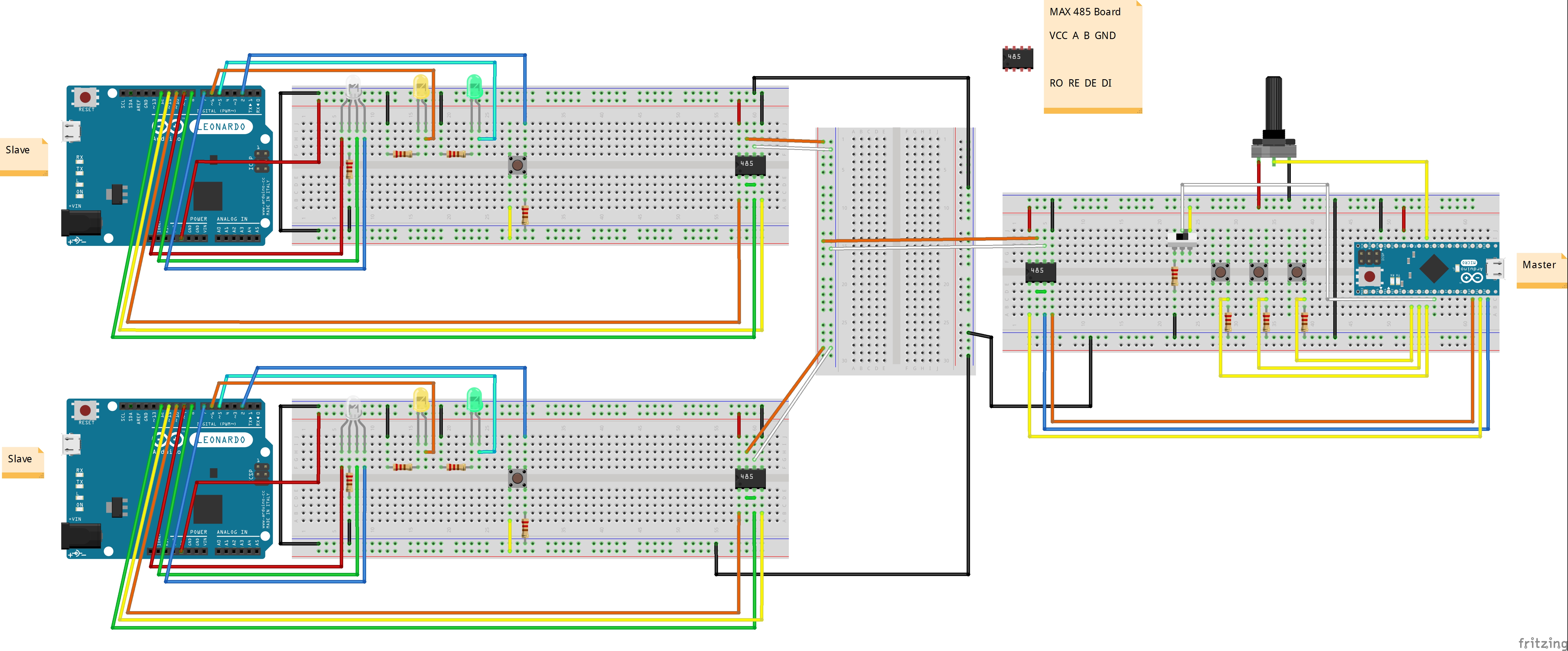
Here’s a picture of the fritzing document, which can be found: here

Thanks for reading!
Beginnings of a web controlled Arduino

Left is putty, right is serial

So I’ve made a bit of progress with the project that I’ve been undertaking lately. I’m trying to control a powerswitch tail from an arduino via the internet using the Ethernet shield and a PHP server.

Right now I can edit a the name of a string (well, echo) in putty on a document on my PHP server (the very same LAMP that’s allowing me to type this post!) and have the Arduino decode that string (echo) and print it back to the serial console at 9600 baud.


You can grab the source for the Arduino here and the PHP script here

See comments in the arduino code for notes about setup. Also deduction is your friend :)

Happy programming!